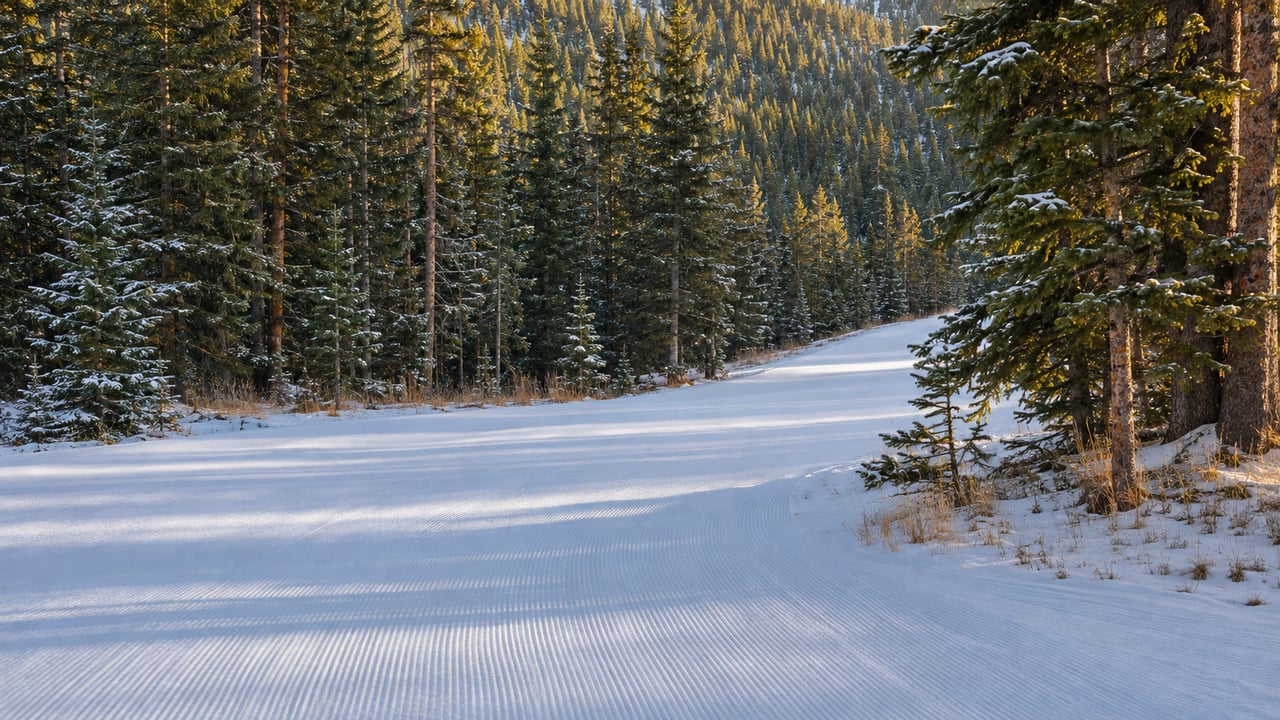
"Having water we can use for snowmaking makes us a reliable destination, especially early and late in the season, and is a huge boon for the rest of the community," Big Sky Resort vice president of operations Adam West told SAM Magazine in June. The water he means is wastewater from homes and businesses across Big Sky, treated at the Big Sky Water and Sewer District's plant and pumped uphill to Spanish Peaks Mountain Club. This winter is planned as the first season it comes out of snow guns on Spirit Mountain, at the Spanish Peaks base near Montage Big Sky, and on parts of Andesite Mountain.
So the early-season surface on the club side of the mountain now depends on Big Sky's sewer system. When the guns turn on, how much they can make, and where the meltwater goes next spring are all set by the community's plant and a state permit, more than by the club's own wells.
The Water Has Been at Spanish Peaks Since June
The plan was supposed to start a year ago. Montana's Department of Environmental Quality issued the permit on October 1, 2025, and it took effect November 1, 2025. That fall, Big Sky Resort's announcement said operations would begin that season. They didn't. According to SAM Magazine, the resort made no snow from reclaimed water in 2025-26 "because some engineering controls weren't ready." Treated water is now "stored and ready for the start of the 2026-27 ski season."
The district's own operating reports show how the water got there. In its June 2026 monthly report, the district says its reuse season began February 19, 2026, with reclaimed water pumped first to the Yellowstone Club. As of June 4, water was going to Spanish Peaks. The same report says monitoring for the A-1 reclaimed-water standard continues to meet regulatory requirements, and that irrigation of the Big Sky Resort Golf Course began in May. The district's October 21 board packet still describes deliveries to Spanish Peaks since June 4, with snowmaking not yet underway.
So this winter's first reclaimed snow has been sitting in Spanish Peaks' storage since early summer.
The Route From Drain to Ski Run
The system is easiest to understand as a route, and each step has a different owner:
- Treatment. Wastewater from across Big Sky goes to the district's water reclamation facility. Montana Free Press reported in 2024 that the upgrade doubled the plant's capacity and improved nutrient removal. SAM Magazine describes the treatment as biological nutrient removal, membrane filtration and advanced oxidation, at 910,000 gallons per day, monitored at several points by a third-party engineering firm.
- The climb. The community is responsible for getting water up to the resort through a series of pump houses and pipes. SAM reports that the community side is paid for with tax dollars.
- Storage. Spanish Peaks is responsible for the storage facilities and retention ponds.
- The guns. The permitted area covers Spirit Mountain, Andesite Mountain and the Spanish Peaks base area. SAM notes that freezing adds another layer of treatment.
- Spring melt. The permit allows snowmelt to drain from snowmaking outfalls into the North and South unnamed tributaries of the Middle Fork West Fork Gallatin River.
Because of step two, the club's early-season snow travels through infrastructure the wider community paid for. West told SAM that the financial burden is shared between Spanish Peaks Mountain Club and the town of Big Sky.
Why Spanish Peaks Needed Another Water Source
Before this project, SAM reports, the Spanish Peaks section of Big Sky Resort used well water for snowmaking, which SAM called "an unsustainable long-term practice." The reclaimed supply roughly doubles that capacity. Under the permit, phase one allows up to 23 million gallons a year, and phase two raises the cap to 44 million, as Explore Big Sky reported when the permit was approved. SAM gives the eventual figure as 43 million gallons. The permit figure is 44 million.
For scale, Montana Free Press reported that the Yellowstone Club pumped about 20 million gallons of treated wastewater for snowmaking in its first reclaimed season, 2023-24. Spanish Peaks' phase-one ceiling is a little above that, and its phase-two ceiling is about double. West traced the Spanish Peaks project to "an initiative by our neighbors at the Yellowstone Club and the Army Corps of Engineers" that began almost 20 years ago.
West explained the goal in terms skiers will recognize. More water is "the opportunity to increase the [snowmaking] footprint so we can open and close on time, stay open through the course of the season, and give the guests who are staying and coming out of that base area a reliable surface to ski over and make it to the rest of the resort." For anyone skiing from the Spanish Peaks side, that connection to the rest of the resort runs over Andesite. The resort's history page says the Southern Comfort and Thunder Wolf lifts connect Lone Mountain to the Spanish Peaks and Lone Moose areas, and that Southern Comfort serves more than 225 acres on Andesite.
A Calendar Set by the Permit
The permit also sets the timing. DEQ's notice limits reclaimed-water snowmaking to the period between November 1 and January 15 each year, depending on weather, with a maximum of 76 days. DEQ expects most of it to happen from mid-November to mid-December.
| Date | What it marks |
|---|---|
| November 1, 2026 | Permitted snowmaking window opens |
| Mid-November to mid-December | Period when DEQ expects most snowmaking |
| November 25, 2026 | Big Sky Resort opening day, 9 a.m. to 4 p.m., at Mountain Village |
| January 15, 2027 | Permitted snowmaking window closes |
| October 31, 2030 | Current permit expires |
The window opens this coming Sunday, about three and a half weeks before opening day. Big Sky Resort says it will post opening-day terrain and amenity details closer to winter. No published plan yet names the individual runs that will get reclaimed snow. Explore Big Sky's 2024 opening-day report listed terrain served by Ramcharger 8, Swift Current, Challenger and Explorer. The new water is aimed at the Spanish Peaks side specifically.
What the Monitoring Watches
Because the meltwater reaches Gallatin tributaries, the permit comes with a long list of requirements. It sets limits and sampling for flow, pH, suspended solids, biochemical oxygen demand, E. coli, chlorine, temperature, nitrogen and phosphorus. It also requires monitoring of streams and snowmelt, including chlorophyll-a, which tracks algae growth, plus annual reports. This winter is planned as the first season that produces that data for the Spanish Peaks project.
The river background explains the attention. In 2024, Montana Free Press reported on recurring algae blooms downstream on the Gallatin. Montana scientists linked algae growth to nitrogen and phosphorus from sources including septic systems, over-irrigation with wastewater, and fertilizer runoff. The Gallatin River Task Force's 2025 data summary found no nuisance bloom on the mainstem Upper Gallatin in 2025. It did record blooms on the South Fork, Taylor Fork and Beaver Creek, and named warm water and low flows as contributing conditions.
Big Sky is the largest "zero-discharge" community in Montana, according to SAM Magazine, meaning much of its used water goes back to the ground rather than directly into the river.
Snowmaking gives that water somewhere to go in winter. Montana Free Press described a system that stores treated effluent through the winter and uses it to irrigate golf courses in summer. Big Sky Resort's announcement lists Trout Unlimited, American Rivers, Greater Yellowstone Coalition and the Gallatin River Task Force among the project's supporters, who say reuse saves fresh water and keeps wastewater out of direct river discharge. Some groups have questions. Montana Free Press reported that Guy Alsentzer of Upper Missouri Waterkeeper asked whether Class A-1 standards and reuse assumptions ensure the water stays in groundwater rather than reaching surface water.
The Next Pipe and Pond
The current setup is the first piece. SAM reports that the resort plans to add more pipe and build more retention ponds over time to make fuller use of the treatment plant. No date has been published for phase two, the step from 23 million to 44 million gallons. "From here, the sky's the limit," West told SAM. "We're going to continue to push this across our property in years to come."
If you would like to talk through what changes like this mean for a home on Spirit Mountain or near the Spanish Peaks base, Sandy Revisky De Leon has followed this side of the mountain for nearly three decades. Let's Get Started.